You must be 21 years of age or older to enter this site.
By entering, you confirm you are 21 years of age or older.
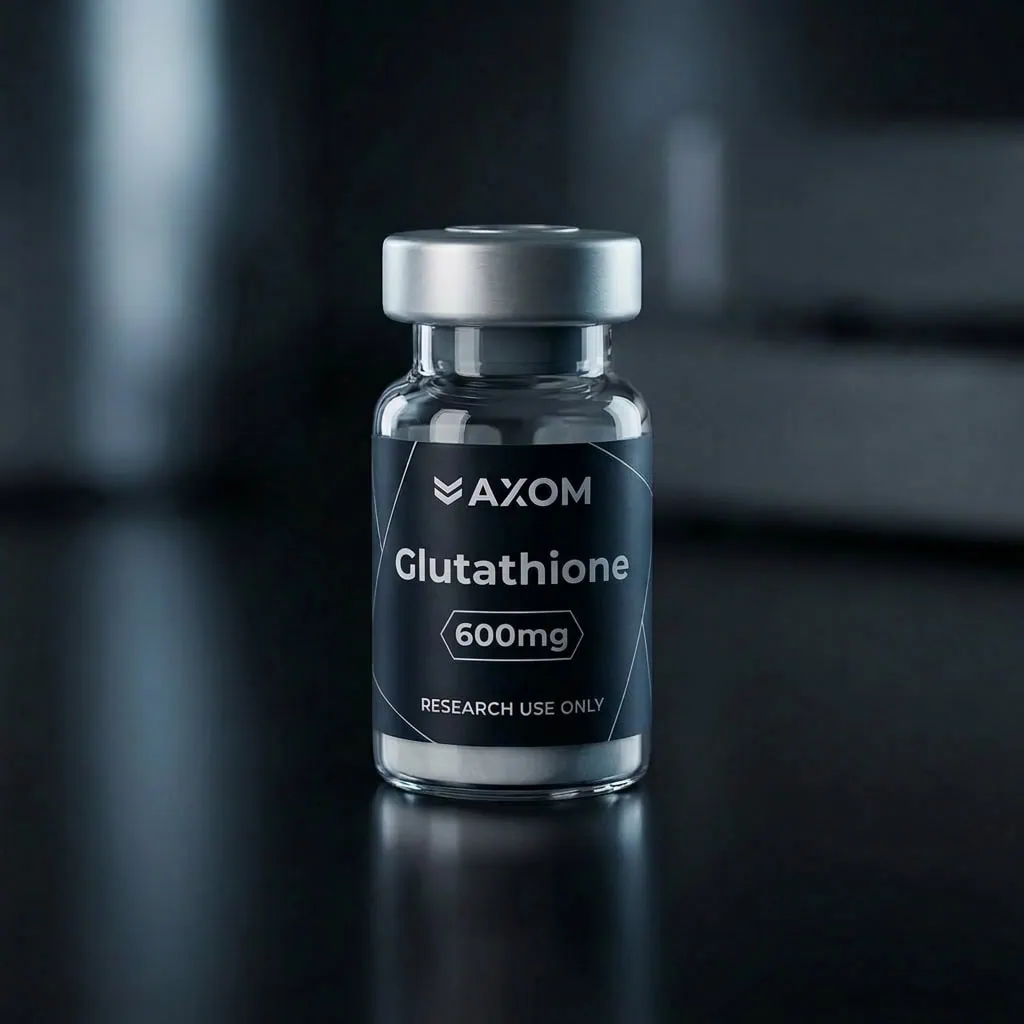
Glutathione (GSH) is a naturally occurring tripeptide composed of glutamate, cysteine, and glycine residues, distinguished by its unusual γ-peptide bond between the glutamate γ-carboxyl group and the cysteine amino group. This structural feature confers resistance to standard peptidase degradation and is central to glutathione's biological stability in research models.
As the most abundant low-molecular-weight thiol in mammalian cells, glutathione has been extensively characterized in published literature as a critical component of cellular redox homeostasis. The reduced form (GSH) serves as the primary intracellular antioxidant, participating in the neutralization of reactive oxygen species (ROS), conjugation reactions catalyzed by glutathione S-transferases, and maintenance of protein thiol status in laboratory assays.
AXOM Glutathione is manufactured under strict cGMP-equivalent protocols and verified to ≥99% purity via reverse-phase HPLC. Each lot is accompanied by a Certificate of Analysis documenting identity, purity, peptide content, and endotoxin levels. Available in 600mg lyophilized format for research use only.
Endogenous tripeptide with γ-peptide bond linkage — the most abundant intracellular thiol studied in redox biochemistry and oxidative stress research.
Contains an unusual gamma linkage between glutamate and cysteine, conferring resistance to conventional peptidase hydrolysis in in-vitro assays.
≥99% HPLC-verified purity with full COA documentation. Every lot independently tested by third-party analytical laboratories.
Comprehensive review characterizing the enzymatic network surrounding glutathione metabolism, including glutathione peroxidases, glutathione S-transferases, and the γ-glutamyl cycle. Detailed analysis of GSH's role as the principal intracellular reductant and its interplay with thioredoxin and other redox-active systems in cellular assays.
In-depth examination of glutathione biosynthesis via the two-step ATP-dependent pathway catalyzed by γ-glutamylcysteine ligase and glutathione synthetase. This study characterizes the regulatory mechanisms controlling GSH levels and the compound's participation in thiol-disulfide exchange reactions relevant to redox signaling research.
Review article summarizing decades of published research on glutathione's biochemistry, including its role in Phase II conjugation reactions, maintenance of ascorbate and tocopherol in reduced forms, and its characterization as a critical cellular thiol in published laboratory studies across multiple research disciplines.
| Product Name | Glutathione (GSH) |
| Synonyms | L-Glutathione, γ-L-Glutamyl-L-cysteinyl-glycine, GSH |
| CAS Number | 70-18-8 |
| Molecular Formula | C10H17N3O6S |
| Molecular Weight | ~307.32 Da |
| Sequence | γ-Glu-Cys-Gly (tripeptide with γ-peptide bond) |
| Structural Feature | γ-peptide bond between glutamate and cysteine |
| Purity | ≥99% (Reverse-Phase HPLC) |
| Form | Lyophilized white powder |
| Available Size | 600mg |
| SKU | LTF-GL-600 |
| Solubility | Soluble in sterile water, bacteriostatic water |
| Endotoxin | <1 EU/μg (LAL method) |
| Certification | COA included with every order |
| Intended Use | For research and laboratory use only |
Glutathione is supplied as a lyophilized powder and should be reconstituted with sterile bacteriostatic water (BAC water) for research applications.
All orders ship within the continental United States via USPS or UPS. Peptides are shipped at ambient temperature — lyophilized peptides are stable during transit. Free shipping on orders over $250.
Buy more of the same item and save automatically at checkout. No code needed.