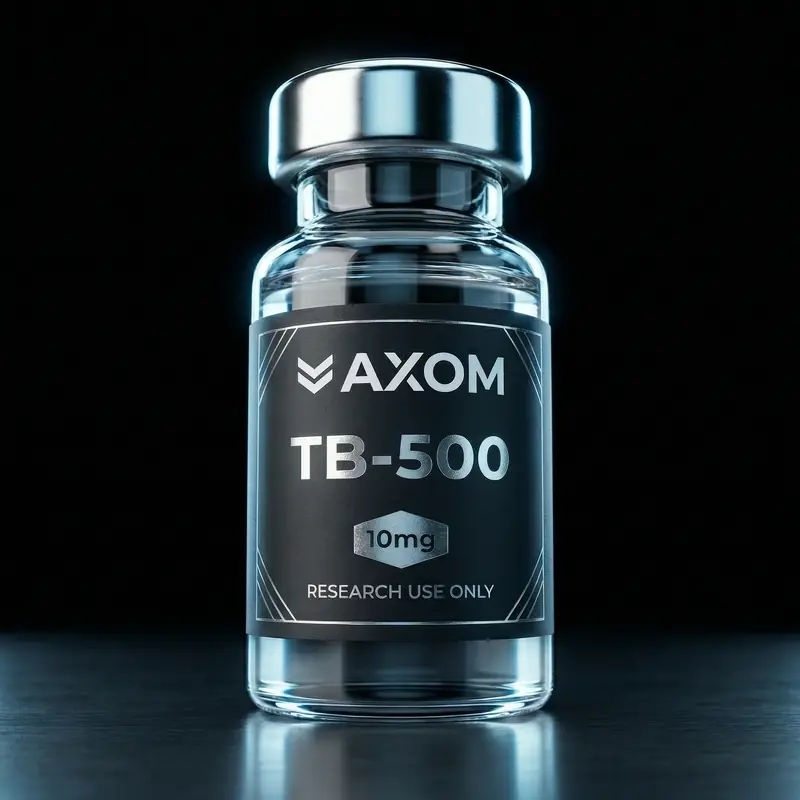
Thymosin Beta-4 Fragment — Tissue Repair Research Compound
In Stock
$79.99
TB-500 is a synthetic 43-amino acid fragment of Thymosin Beta-4, studied for tissue repair, cell migration, and anti-inflammatory activity in research models. Supplied as ≥99% HPLC-verified lyophilized powder. For research use only.
Quantity
1
Vial
$79.99
$79.99 / vial
Save 12%
2
Vials
$139.99
$70.00 / vial
You save $19.99
Save 21%
3
Vials
$189.99
$63.33 / vial
You save $49.98
≥99% Purity
cGMP Certified
3-Day Delivery
TB-500
10mg • 1 Vial
Save 12%
Save 21%
43-Amino Acid Peptide
Synthetic analog of naturally occurring thymosin beta-4
≥99% HPLC Purity
Every lot independently verified by third-party laboratories
COA Included
Full Certificate of Analysis with HPLC, mass spec, and endotoxin data
About This Compound
What is TB-500?
TB-500 is a synthetic version of a naturally occurring 43-amino acid peptide present in virtually all human and animal cells. Thymosin Beta-4 was first identified in the thymus gland and has been the subject of extensive research since its discovery.
Published preclinical studies have investigated TB-500's role in cell migration, blood vessel formation, and cellular differentiation processes. The compound interacts with actin, a cell-building protein critical to cell structure and movement.
Manufactured under cGMP-equivalent protocols and verified to ≥99% purity via reverse-phase HPLC. Full COA included with every order.
Supplied as a lyophilized white powder. Soluble in sterile water and bacteriostatic water. For research and laboratory use only.
Technical Data
Specifications
CAS Number77591-33-4
Molecular FormulaC₂₁₂H₃₅₀N₅₆O₇₈S
Molecular Weight~4,963 Da
Sequence43 amino acids
Purity≥99% (HPLC)
FormLyophilized powder
Storage-20°C (lyophilized)
Endotoxin<1 EU/μg
Published Research
Peer-Reviewed Studies
Thymosin β4 activates integrin-linked kinase and promotes cardiac cell migrationBock-Marquette I, et al. • Nature, 2004
Thymosin beta 4 promotes angiogenesis, wound healing, and hair follicle developmentPhilp D, et al. • Ann NY Acad Sci, 2007
Thymosin beta-4 and cardiac repairSmart N, et al. • J Mol Cell Cardiol, 2007
Common Questions
TB-500 FAQ
TB-500 is a synthetic version of thymosin beta-4, a 43-amino acid peptide found naturally in human and animal cells. It is intended exclusively for in-vitro and laboratory research.
Verified at ≥99% purity via reverse-phase HPLC. Each lot includes mass spectrometry confirmation and endotoxin testing. Full COA included.
Lyophilized: -20°C long-term, stable at 2–8°C for 90 days. Reconstituted: 2–8°C, use within 28 days. Protect from light.
Yes. Every order includes a lot-specific COA with HPLC chromatography, mass spec data, peptide content, and endotoxin levels.
Orders before 2PM EST ship same day. Standard delivery is 2–4 business days within the continental US. All orders include tracking.
Still have questions about TB-500 or any of our research compounds?